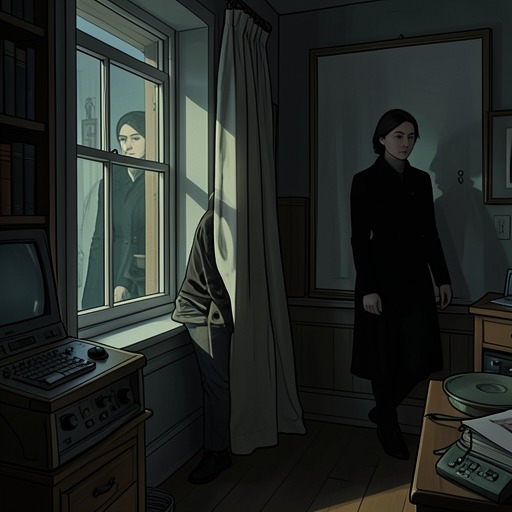
“Keep it bouncing”
The Crying of Lot 49“Keep it bouncing” is Pierce Inverarity’s remembered maxim to Oedipa Maas, and at the novel’s close it becomes an unsettled key to both his character and her inheritance. Its buoyant command to sustain motion carries a darker counterweight: the will may have been an attempt to keep a scheme moving beyond death, or merely one last act of harassment, and Oedipa cannot decide which possibility is true.
The remembered instruction
Oedipa recalls Inverarity telling her, “Keep it bouncing,” and explaining that this was the secret. The brief phrase comes from a relationship in which she had known only a fraction of his business self. She understands that his need to possess and alter the land—to produce new skylines, personal antagonisms, and growth rates—exceeded what their love, such as it had been, could measure. The maxim thus evokes more than motion in the abstract: it belongs to the expansive, transforming force through which Inverarity remade the landscape around him.
Motion against an ending
The recollection occurs as Oedipa walks beside a railroad track, with spurs running into factory property that may also have belonged to Inverarity. She wonders whether it matters whether he owned all of San Narciso, since the town’s boundaries seem to dissolve into a larger continuity of American life. Against this image of sprawling development, the bouncing maxim acquires a limit: writing the will, Inverarity must have faced the possibility that his own movement would stop.
Oedipa considers incompatible explanations for the will. Inverarity may have used it cynically to harass a former mistress, sure that death would erase any further hope; he may have discovered the Tristero and encoded a clue to it in the testament, so that she would find it; or he may have been trying, through paranoia or conspiracy, to survive death. The remembered phrase gives these conjectures a common shape: each asks whether something set in motion by Inverarity could continue after him. The text does not settle the question.
The phrase at the novel’s close
Oedipa also allows for the plainest possibility: Inverarity simply died, and she discovered the Tristero by accident. If the mystery exists, she thinks, it might have been encountered anywhere in the country through one of many concealed entrances or alienations. Standing between the rails, she recognizes how the tracks join and extend beyond her immediate view. The railroad’s physical network echoes the continuing motion of the phrase, while offering no proof of who set that motion in train.
“Keep it bouncing” therefore remains neither a solution to the Tristero mystery nor reliable evidence of a final message from Inverarity. Its force lies in the tension between continuation and cessation: the command recalls a man whose projects seemed to enlarge without limit, while Oedipa confronts a death that may have ended everything—or may have left consequences and connections still moving beyond her knowledge.